About:
This movie was a biographical/historical film highlighting the legacy of Fred Hampton through the perspective of informant William O’Neal. Producers and staff crafted a wonderful portrayal of who Fred Hampton was at his core while also staying true to the historical events that took place during his time as the Illinois chapter deputy chairman of the national Black Panther Party. The movie starts out with J. Edgar Hoover (played by Martin Sheen) speaking to a group of CIA operatives in a meeting, spreading false accusations about the Panthers. The movie then picks up from the perspective of O’Neal (played by LaKeith Stanfield) as he gets caught stealing a car and impersonating a cop. He was taken into custody and was given an ultimatum: “Serve time in jail or become an informant and infiltrate the Black Panther Party Chicago chapter,” in which he chose the latter.
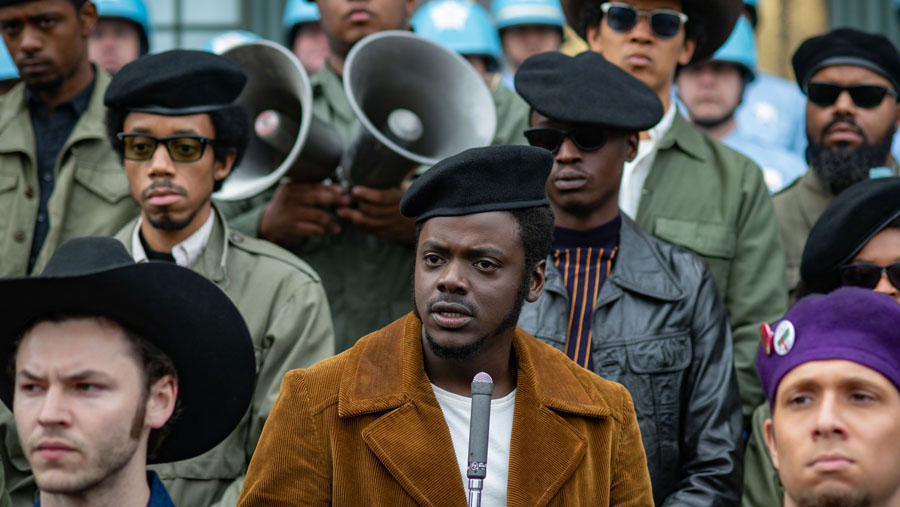
Fast forward; we are introduced to Fred Hampton (Daniel) at a Black Panther event speaking on the dangers of capitalism, as well as expressing the hope of the Black Panther Party to liberate Black peoples from the oppression of corrupted systems. After this rally, he was introduced to Deborah Johnson, who would eventually end up being his fiancée. Bill would gradually integrate himself into the party by attending their events and updating agent Mitchell on all of the party’s initiatives. To get closer to Fred, Bill asked to be his driver, which Fred gladly accepted since he didn’t have a personal vehicle. Through excursions around Chicago, Fred’s main goal was to establish a coalition of different groups of people who were suffering from the same struggle as the Panthers. He pursued gangs, political organizations, community groups, and activists. The coalition would later be recognized as the Rainbow Coalition. The FBI saw the “threat” to national security growing too powerful, so they eventually arrested Fred on faulty allegations. After his arrest, Bill grew to higher ranks within the organization, allowing him to have a greater influence in his manipulative ways to infiltrate the organization. When a police shootout with the Black Panthers happened at main headquarters, Bill snuck out the back, avoiding danger but risking revealing his true identity. The police proceeded to bomb the Black Panthers’ headquarters and arrest the involved members in the shootout. Bill tried to quit his deal with the FBI after his close call, but was unable to. Meanwhile, the community gathers around the scene of the massacre. Eventually, everyone puts their hands together to rebuild from square one, renovating/fixing the beaten-down building. Everyone from the street gangs to the kids contributed to the restoration of the Black Panther headquarters. Meanwhile, Fred is having a rough time being locked up, beaten, mistreated, and abused. The only mail he received was the one that would psychologically break him: news about the police raid. After Hampton is released from prison while appealing his charges, he reunites with Deborah, now pregnant with his child. A BPP member, Jimmy Palmer, who was hospitalized after being shot by a police officer, is killed while being transferred to another hospital. Enraged upon learning of Jimmy’s death, fellow member Jake Winters engages in a shootout with police, killing several officers before being gunned down himself.
One of the most memorable scenes in the movie was Fred Hampton organizing a mass meeting and delivering a feverish speech that inspired everyone in attendance. This moment showed that Fred was willing to do whatever it takes to liberate his people and stand up for his beliefs… even if it meant death. As he would repeatedly state, “I’ll die for the people.”
Oneal was tasked with taking out chairmen after that. Oneal was instructed to put sedatives in his drink and provide blueprints to the layout of Fred Hampton’s main residence. During a gathering at Fred’s residency, Oneal hesitated but ended up fulfilling his duties. Later that night, the police raided Fred’s house and shot him twice to make sure he wouldn’t survive.
The film ends with archive footage and O’Neal’s 1989 interview.
The Parties’ Mission:
Breakfast for children: The Black Panther Party created an initiative centered around feeding children/students before they go to school. Backed by research, they understood that breakfast was the most important meal of the day and had a high upside in improving academic performance. This community service program facilitated the reduction of the effects of poverty struggles. Originally started in late January 1969 at St. Augustine’s Episcopal Church in West Oakland, California, the movement quickly picked up steam and traveled across most of the major cities. The program was mainly run by volunteers. Their contribution not only distributes nutritious food for the underserved, but they also provide education and a safe space for the kids to matriculate and grow. Kids and their families were given the opportunity to understand policy, Black pride, and revolutionary consciousness. This initiative was impactful and was the most central organizing activity of the Black Panther Party.
Chicago: Fred Hampton helped organize 5 different breakfast programs on the west side of Chicago. The Chicago chapter served more than 400 children. The success and visibility of the party drew significant public attention, ultimately pressuring the government to respond to the social needs that the party had been highlighting. In many ways, this government response was the very outcome the party had hoped to achieve.
The Rainbow Coalition: The Rainbow Coalition was an alliance between different groups of marginalized people to challenge authority and liberate themselves from the oppression of the corrupted governing system. This organizing effort was established in Chicago, led by Fred Hampton and the Illinois Chapter of the Black Panther Party. This social-political organization’s premise was centered on class solidarity and uniting people (poor, working class) across racial lines. Everyone involved helped contribute to the shared vision of providing education, food, and health care to their respective communities.
People’s Free Medical Clinics: The Black Panther Party instituted free health care clinics for their communities, combating the health disparities among community members and improving access to quality care. In 1968, Black Panther Party chapters in Kansas City, Chicago, and Seattle established the first free people’s medical clinics. These services were an alternative to President Lyndon Johnson’s Great Society community health centers, since they were ineffective and failed to address the systemic inequalities. Ten additional clinics were opened in 1970 when the Black Panther Party required that all chapters establish clinics. Physicians, nurses, pharmacists, lab technicians, and medical students who also trained community members to staff the clinics as lab technicians, patient advocates, and community health workers all did pro bono work to help contribute to the growth and sustaining power of these clinics. The services provided included vaccinations and basic screenings. They also began community education and screening of sickle cell anemia, a genetic disease mainly affecting people of African ancestry. Research has been extremely limited about this specific disease, which is why the Black Panther Party targeted it. They not only provided screenings/education, but they also did research. This all forced the government to pass the National Sickle Cell Anemia Control Act of 1972. The Act created national genetic counseling, testing, and research to diagnose and treat sickle cell anemia. This government policy change did not come so easily, as the police consistently raided the Black Panthers’ medical clinics and constantly harassed them with health inspectors. But, in the end, the move provided the necessary shift in policy to help more African Americans and their struggles with the health disparities of the time.
Movie/title symbolism
So, why the title “Judas and the Black Messiah”? Well, the story of Judas betraying the messiah, Jesus, is well known. He sold out Jesus for silver and gold, giving up his location and identity. Fred, in many ways, resembles the messiah. Sure, he is not holier than thou, but the title was not meant to disseminate that message on his behalf. Rather, being a messiah in this case simply means being a leader and a savior of a group of people. As he continually repeats in his dialogue, he is a revolutionary, a liberator, and a freedom fighter, standing up for the oppressed and shifting the paradigm that suggests it is ok to step on the necks of those we deem less than based on cultural and racial differences. Another parallel that may be a direct symbolic representation of who Jesus was is Fred’s conscious effort to be willing to sacrifice himself for the people. Regardless of the cost, Fred is willing to go to the depths required to achieve liberation for his community. From the point of view of O’Neal, he was a part of Fred’s inner circle and compromised Fred by selling him out and physically contributing to his demise. Similar to Judas, O’Neal was a selfish backstabber. But unlike Judas, he was motivated by self-interest. He wanted freedom and was willing to go to the depths to gain his freedom, even though it meant going against his morals. He would struggle with the internal push and pull of what he was doing, and in a similar fate as Judas, he allegedly killed himself in a car accident.
Motivating theme:
It is undeniable to dismiss the work the Black Panther Party has done. Extrapolating from their exceptional work, we can see a blueprint for achieving social reform through organizing and taking matters into our own hands. The Black Panther Party did not wait for handouts from the government; rather, they took the initiative to address the concerns of the people themselves. Some of the strategies they used are similar to the emergent strategy framework. Although the term “emergent strategy” was coined later, the Panthers’ approach perfectly modeled this concept. Emergent strategy is an approach to social change that relies on adaptation, relationship-building, and continuous learning. By strengthening small, interconnected networks and decentralized forms of leadership, it allows collective actions at the local level to grow into transformative change across systems. The Black Panthers embodied this by constantly adapting to the political climate and fine-tuning what we would all see as the final product: medical clinics, breakfast programs, and the Rainbow Coalition. They exemplified being a revolutionary, decentralized-led organization by empowering community members to take responsibility and allowing local branches to operate autonomously to address specific community needs. They also had strong relationship-building skills, which were evident throughout the Rainbow Coalition initiative.